Wednesday, 15 September 2010

BACK FROM THE DEAD< JUST!!! AND ARE YOU FLEXIBLE ENOUGH TO RUN?


Good news managed the session today 8 x 6 mins at 1/2 marathon pace with 2 mins active recoveries between each effort at about 6.48 pace.
I don't know about you but the weather over here is really crap right now, with near gale force winds and blustery showers!
I headed for the Kings Gardens and as much shelter as I could get, but it was still tough going with the worst of the wind and showers for my last two efforts, someone really doesn't like me !
Here are my 6 min effort paces;
1/ 5.58 pace 2/ 5.54 pace 3/ 5.54 pace 4/ 5.57 5/ 5.58 6/ 5.56 7/ 6.08 8/ 6.02
Average pace of session inc rec 6.18, 9.97 miles in 1.02.50
Total time inc warm up-down = 1.27
Felt pretty strong until the 7th effort when I was hit by a blustery shower and even stronger winds, lost my concentration for a bit, i recovered and tried hard on the last one!
Tough session, glad I made it through.
Sciatic nerve a bit sore by the end but going for treatment tomorrow!
Posture Tips to self; keep hips pushed forward and run tall
They say if it don't kill you, it will make you stronger!
Mmmm, But that's just crazy talk,
Right!

Are you flexible enough to run ?

By Bob Prichard

Somax Performance Institute

Hamstring Range

Hamstring flexibility is critical to running. If your hamstrings are tight, they will restrict your Stride Angle, the maximum opening between your front and trailing leg. The bigger the Stride Angle, the faster you can run. For each degree you increase your Stride Angle, you add 2% to your stride length. With just a 10º in Stride Angle, you will cover an additional, effortless 20% more ground with each stride. Runners get tight hamstrings from crossing their legs over toward the midline as they run.

How to Measure

To measure your hamstring range, lie on your back and, keeping your knee locked straight, raise your leg as high as you can. Do this with the other leg. On the photos of your ranges, measure your range by drawing a line from the center of your thigh through the center of your ankle. Measure this line in relation to horizontal, as you see here.

You need a minimum range of 135º in order to run without your hamstrings holding you back. The biggest hamstring range we have ever measured in a runner was 180º.

Hip Flexion Range

Hip Flexion is critical to running speed. You need a lot of flexibility in this range in order to keep your knees high while you run. If your hips are tight, you will drop your knees and reduce your Stride Angle. For every degree you drop your knee, you reduce your stride length by 2%. Just a 10º drop and you will reduce your stride length by 20%. This happens often to runners with low Hip Flexion range. Because the hips are tight, the muscles that lift the knees tire quickly and the knees drop. Runners tend to make up for this knee drop by overstriding—which leads to injury. This is why runners get injured when they are tired.

How to measure

Lie on your back and pull your knee up toward your chest without bending your other knee. Do not use your hands to pull up your knee, as you don’t do this while you run. Have someone take a picture. Now do the other knee.

Draw a line through the center of your upper leg, and a vertical line through your hip, as you see here. Measure the angle between the lines. Do both legs. You need a minimum of 90º of Hip Flexion, or your hips will interfere with your running.

Hip Extension

Runners need lots of Hip Extension in order to achieve a good Stride Angle (110º or more) while they run. Poor hip extension is the primary reason runners bounce up and down so much when they run. A runner with a 3” bounce (typical for elite runners) runs up 1.24 vertical miles during a marathon, and drops down another 1.24 vertical miles, adding an additional 2.48 grueling miles to the marathon.

How to Measure

Lie on your stomach. Be sure to keep the hip bone at the front of your hip on the floor or table. This is difficult for most runners to do, as their hips are so tight that as soon as they lift their leg, they lift their hip. Make sure whoever is taking your photo confirms that your hip is on the table as you lift your leg as high as you can, without lifting your hip.

Do not be surprised if you have less than 60° of hip extension. This is usually the tightest range in runners. Tightness in this range is also the cause of many back problems in runners.

Once you have good photos (with no hip lift) draw a line through the center of your upper leg and measure that in relation to a horizontal line, as you see here. Do both legs.


Measuring Hip Extension

If you are not sure about how to measure your ranges, just email us your photos, and we will measure for you. Our email address is bprichard@somaxsports.com

If you have any questions, please call us at 1-800-227-6629.

Somax Performance Institute


NICE VIDEO FROM THE RYAN HALL GROUP!
OK, I'm going to get some photo's of my flexiblity or lack of it and post it soon.
Tell me how you do, is your flexibity good ?

Tuesday, 14 September 2010

RUBBISH 5 K HANDICAP 15th Sep AND TRAINING UPDATE!

RACE STARTS 7pm PROMPT
Details HERE

Training update
With less than 2 weeks until the Langdale Mountain Marathon I find myself injured with a reoccurring Sciatic problem.
I'm hoping a trip to my Chioprator on Thur can sort me out!
The problem started to flair up at the start of last week and my final 3 hour run of my marathon training programe finished me off :[
I only have to do 3 sessions this week anyway, after resting Mon-Tue I'll see how I go tomorrow then get the problem sorted by Dr Fullwood on thur.
Wish me luck!

Saturday, 11 September 2010

HOW TO RUN FASTER-MODERN SCIENCE WRONG?


Steve Cram had one of the longest strides of his generation, modern science tells us that stretching is bad for running performance, yet Steve gave this advice to this question: [below]

To get faster, should I increase stride length or turnover?

Steve Cram says: ‘Both will help, but don’t try to increase your stride length by changing your running action. Instead, aim to increase your flexibility in your hamstrings and quads, which will add length. Gentle downhill running will increase leg speed because it encourages you to move quicker. Also, do intervals where you consciously increase your cadence.’

How not to run-British athletes stride too short!

UK Prime Minister David Cameron recently led some of his Afghan troops in a run and provided an excellent example of how not to run.

David Cameron Running Too Upright

David Cameron Running Too Upright

It’s not efficient to run upright. Even the soldier to his left has 8 degrees of forward tilt. Most elite runners have 13 degrees. The only time an efficient runner runs upright is to slow down after crossing the finish line.

David Cameron's Tiny Stride Angle

David Cameron's Tiny Stride Angle

Our research has found that you increase your stride length 2% for every degree you increase your Stride Angle. The inverse is also true. You decrease your stride length 2% for every degree you decrease your Stride Angle. With a 70-degree Stride Angle (one of the lowest we have measured), David Cameron is covering 40% less ground than the average, slow marathon runner. Good marathon runners have a Stride Angle over 100 degrees, which means that Cameron is covering 60% less ground than they are. Samuel Wanjiru, for instance, won the 2008 Olympic Marathon with a Stride Angle of 106 degrees. It highly unlikely that Cameron and his soldiers are running a marathon in the Afghan desert. Generally speaking, the shorter the distance, the bigger the Stride Angle.

Why does David Cameron have such an inefficient stride? Basically, he is tense and stiff. You can see evidence of this tension in his toe lift, which is a phenomenal 27 degrees. Good runners don’t bother to lift their toes when running, as it is a waste of energy. Plus, when the toes are lifted like Cameron’s, it forces the runner to land on his heel, which slams the foot flat on the ground, violently stretching the very muscles that the runner is contracting to maintain toe lift. This forceful stretching of contracted muscles tears the tens of thousands of tiny muscle fibers that make up the shin muscles. This leads to fatigue, shin splints and even stress fractures. Efficient runners not only don’t lift their toes while running, they often have negative toe lift.

David Cameron's Dreaded Toe Lift

David Cameron's Dreaded Toe Lift

Other evidence of Cameron’s tension is his hands. As you can see here, he tenses up his hands and fingers as he runs, another waste of energy. Compare his hands to his soldier to his left.

David Cameron Tenses His Hands

David Cameron Tenses His Hands

Unfortunately for Britain, host to the 2012 Olympics, a tiny Stride Angle is not confined to their Prime Minister. Nearly all the ‘elite’ British runners we have measured have tiny Stride Angles. Here are photos of their ‘best’ runners.

Jemma Simpson runs the 800 and 1500 for Britain with a Stride Angle of only 84 degrees. Little wonder that she is so ineffective internationally, where most of her competitors have a Stride Angle over 100 degrees.

Lisa Dobriskey managed only a 4th place finish at Beijing because of her tiny Stride Angle.

Christine <span class=Ohuruogu's Tiny Stride Angle" width="207" height="300">

Christine Ohuruogu's Tiny Stride Angle

Christine Ohuruogu squeaked to a win at Beijing in the 400, but managed just 5th and 6th place finishes in big meets in 2009.

This is what the competition looks like. Sanya Richards of the USA had the top four fastest times in the 400 in 2009.

800m runner Michael Rimmer did not medal at Beijing and managed only 4th place at the Bislett games this year because of his tiny Stride Angle.

1500m runner Andrew Baddeley is one of Britain’s ‘top’ runners, but finished 8th at the Beijing finals and 11th in the semi-finals in Berlin this year.

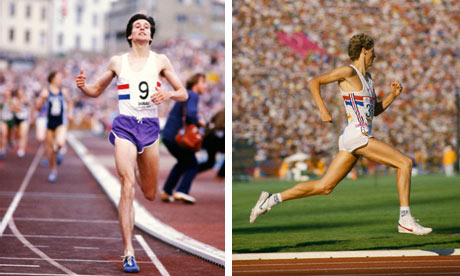
Britain was not always so poor at middle-distance running. In the early 1980′s, Britain dominated middle-distance with Sebastian Coe. Of course, he had large Stride Angle.

Of course, it’s quite easy to increase the Stride Angle in runners. We do it every day at Somax by releasing tension and microfibers.

Stride Angle Before <span class=Somax" width="200" height="178">

Stride Angle Before Somax

Stride Angle After <span class=Somax" width="200" height="178">

Stride Angle After Somax

Increasing our runner’s Stride Angle from 95 degrees to 125 degrees took just a few weeks and enabled him to increase his stride length by 60%. Most of our recreational runners cut a minute per mile off their running pace after we increase their Stride Angle.

You would think than anyone could look at pictures of Sebastian Coe and the current crop of British runners and see that they need to increase their Stride Angle. But runners in Britain don’t see things this way. I told a British marathoner many years ago that we could improve his marathon times immediately by increasing his Stride Angle. He replied that ‘we believe that every runner is born with his own running style and shouldn’t try to change it. You have to play with the hand that was dealt to you.’

Thankfully, they don’t have the same attitude about their buildings, airplanes, cars, bridges, telephones, clothes, cameras, Army and Navy or they would still be fighting in wooden ships and flying in wooden planes.

Perhaps the shock of losing every race at the 2012 London Olympics will force them to rethink their ideas and Britain may one day regain the well-deserved glory they enjoyed in the 80′s.

Ryan Hall: Hip and Glute Stretches to Stay Injury-Free

THE AMAZING LONG STRIDE OF STEVE CRAM

CLICK ON PHOTO'S TO ENLARGE


Monday, 6 September 2010

2 Hour Marathon | An American Record?


Tweeted by stevemagness
Steve says;
this is the funniest misuse of biomechanics I've seen- wow, just wow: americans can run sub2hr marathonNow!

David Cameron–how not to RUN CLICK HERE

David Cameron Running Too Upright

David Cameron's Tiny Stride Angle

OK GUY's AND GIRL'S WHAT DO YOU THINK, LOAD OF RUBBISH OR SOME REALLY GOOD POINTS?
Sebastian Coe and Steve Cram

Friday, 3 September 2010

You can’t do that!

By Vern Gambetta
How many times have you had people tell you could not do something?
I have and for me I always took it as a challenge. Thank God I never listened to all the people who told me I could not do the things I have done. I truly believe people say this to put limits on people, because they cannot imagine doing the things they say can’t be done themselves. I was labeled stupid more once during elementary and high school years (I have the D’s and F’s to prove it), but somehow I have overcome my stupidity to write a few books and accomplish a few other things. Don’t ever take no for an answer, don’t let people tell you can’t do something. Go out and do it and prove them wrong. They told me we could never do the things in baseball that we did we did with the White Sox, but we did it and it worked. Everyone has been trying to imitate what we did ever since with no idea why it worked. I could go on and on, but when I hear someone tell someone especially a young person they can’t do something, I get my dander up, don’t listen to the naysayers, go out and prove them wrong. That is what I try to do. Everyday try to do something that no one else has done. That is how you become the best at what you do.
Vern's Blog


How To Achieve Perfect "Organic Posture" By posturedoc


Thursday, 2 September 2010

Coasters GB "Just a bunch of people running round the Great British coastline ..."

<span class=
Any Southport waterloo A/C members and anyone interested in running one of the final relay legs
Flint - Blackpool

Hi my name is Sandie Jardine and i am one of the coasters helping to carry a cheeky little wooden baton (Barry) around the beautiful coastline of the UK,
one of your members is on our forum and has suggested some of your runners would like to take part, which is great news,
If this is so please visit the Coasters GB website and find out a bit more, I am co-ordinating Barry`s final leg which is Flint to Blackpool ending up on the pier which he gamely left on the 9th of May 2010. You can either contact me by emailing or via the forum flint to Blackpool thread, (Nurse Gladis) and i will get you involved if your runners are interested. It would be lovely to have you aboard.
Kindest regards
Sandie

COASTERS GB WEBSITE LINK The thumb

RYAN HALL - Uphill Runs: Build Power & Aerobic Fitness


Interview - Catherine Ndereba

An Unlikely Journey Through Running

By Steve Magness READ